Wednesday, June 13, 2007
Project Citizen Malawi Southern Regionals June 12th
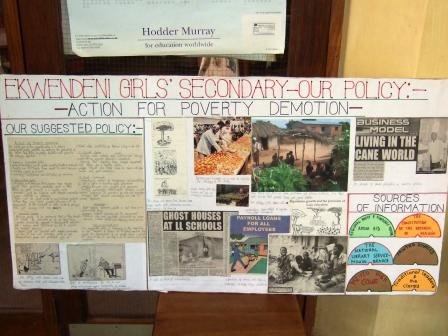
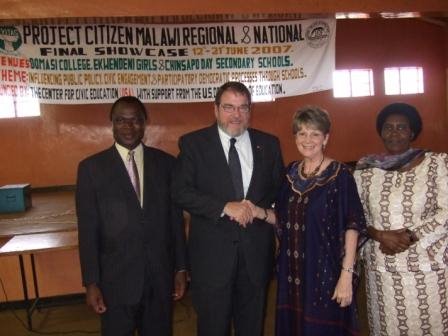
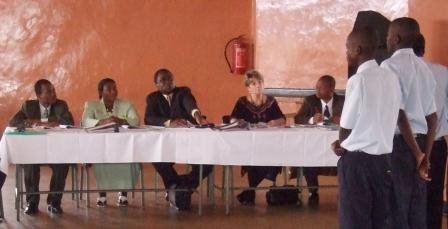
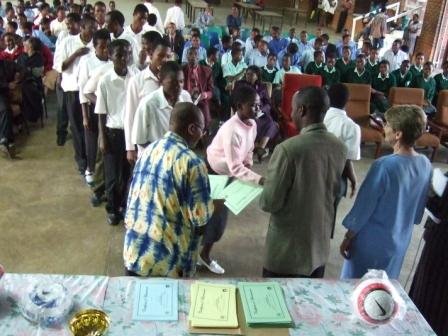
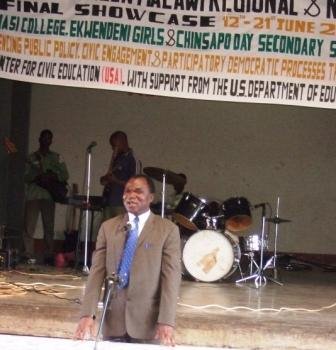
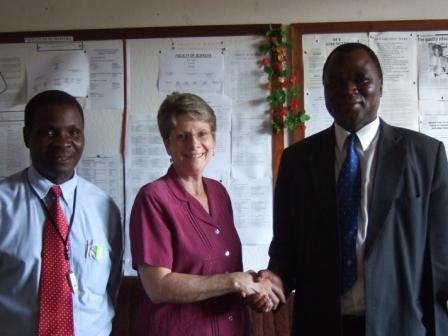
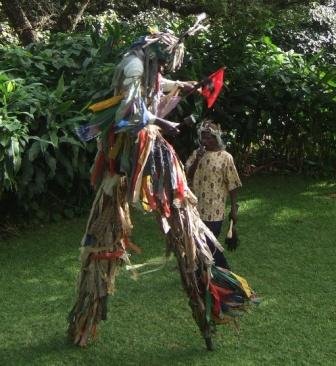
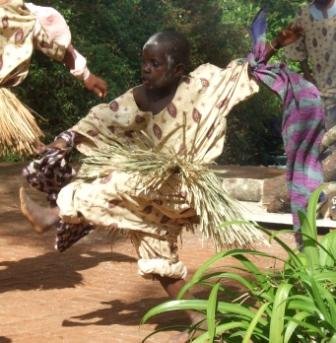
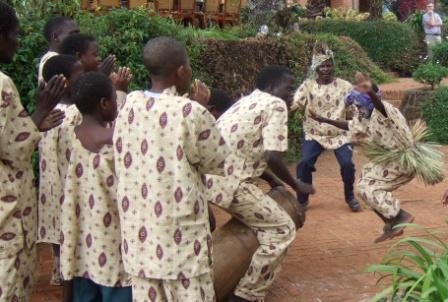
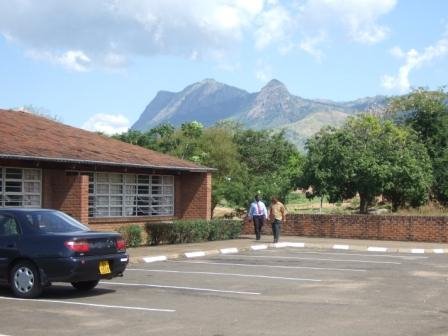
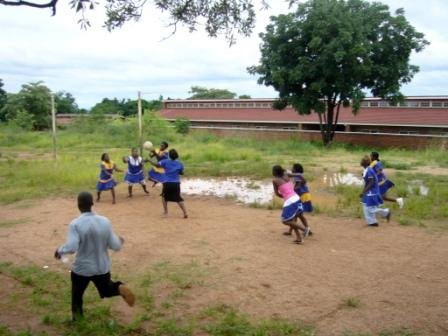
Here and below are a couple of wonderful pictures that capture the spirit of the event that was held over the last two days at Domasi College of Education. Project Citizen Malawi held their first regional showcase (we don't use the word 'competition' here) from which one school was chosen to go on to the finals to be held in the Capitol City, Lilongwe, on June 21. At Domasi, 6 schools attended, bringing 16 wonderful, hard working students each. I leave today for the Northern Regionals in which 3 smaller village schools will showcase their work, and then at the Central Regionals in Lilongwe several days later, 8 more schools will do the same to represent their area. At the finals, we are honored that the U.S. Ambassador, Alan Eastham, has agreed to be our special guest who will announce the awards and praise the students. Also attending as honored guests will be various members of the Ministry of Education, inculding the Deputy Minister who will give the keynote address. This is such amazing progress since Civitas Malawi was founded by Mishek Munthali, Domasi College of Education, only two years ago. His team's hard work, commitment and dedication is showing deserved rewards. And as the Principal (or President) of Domasi College told the students and audience yesterday, their work will travel well beyond the walls of their classrooms now, and beyond to their families, communities and country. Mr. Munthali also told them that they are the "hope of Malawi." I was so proud to be a participant as a judge and thrilled to be a witness to the serious work of so many students, teachers, schools and patrons.

Thursday, June 7, 2007
Teachers working under the cool shade tree

The beautiful campus of Domasi College of Education is the site of the Civitas Malawi teacher education workshop.
Our In-Service Teacher Workshop, June 5-6

Civitas Malawi Country Director, Misheck Malawi and Dr. Fay Kelle lead Workshop for teachers.
Domasi College of Education In-Service Teacher Workshop

Tuesday and Wednesday, June th and 6th, we hosted our first in-service teacher training on teaching democratic citizenship. We held the workshop in the Center for Distance Education on the campus of Domasi college of Education. I led the discussions on the foundations of democracy and citizenship and how those principles should influence our teaching across the curriculum; and, Civitas Malawi country director, Mischeck Munthali, led the discussions about Project Citizen curriculum and activities in Malawi today. Fourteen teachers from the surrounding area attended the first day, then, a few more joined us on the next, for a total of 16 teachers and one District Manager. It was a deeply rewarding experience from which I learned a great deal about the high quality, integrity and commitment of the excellent teachers that attended. Here are some picutures reflecting our experience in the classroom and in the break-out sessions during the two-day workshop.
This afternoon I am off to Zomba, the home of the University of Malawi, the Chancellor's College, to make a one-hour presentation on "Education for Democratic Citizenship." I'll post a report of that event soon. Thanks so much for following my posts. If you have any questions or suggestions, you can send them to me at fay.kelle@yahoo.com. Best wishes, Fay
Thursday, May 31, 2007
School Children Work on Public Problems with Project Citizen Assignment
May 31, 2007
I’ve done some sightseeing, and now I’m getting to the exciting business of working with teachers who want to teach democratic citizenship and economic leadership skills. My orientation to Malawi schools is revealing a stark contrast between their schools and those in the U.S, however, there are some similarities. The school system here is making progress under the current regime of President Mutharika, however, it is an uphill battle.
One might mistakenly think that since the problems are so prevalent and long lasting, that the children (and their parents) become accustomed and/or adapted to the problems. Take a look at this!
The first step school children take in the Project Citizen curriculum (which is my job this summer to help teach teachers) is to discuss and choose a public problem that they would like to research and explore how to solve by trying to influence public policy (i.e., government and other public authorities). This is part of the Civitas Africa curriculum that is designed and promoted by the Center for Civic Education, Calabasas, CA (funded by an Act of Congress and USAID).
Related to schools, these are the problems school children have said they would like to work on while fulfilling the Project Citizen assignment:
Teasing and bullying
Sexual harassment and rape
Toilets (not just clean ones but functional toilets)
Safety in their commute to and from school; many girls would prefer to live in a weekly hostel, but they are seldom available except to those who attend private schools
Hunger is a problem since many come without eating but the schools seldom provide food
Exhaustion, especially when the girls get up around 4-5 am to do house chores before walking long distances to school, often unaccompanied
In primary grades, student-teacher ratio can be 100-350 to ONE teacher (in secondary, there are fewer students who make it to that level—one in 10,000—so the ratio is naturally smaller; then, about 1 in 100,000 make it to college level education.
School buildings without roofs or plumbing, e.g., water for drinking or washing
Few, in any, school supplies such as pencils and paper
Some students chose the following problems:
“Schools do not teach skills that adequately prepare students to get jobs when they graduate,” especially because so few advance to secondary because of lack of funds or they are needed at home to work, especially the girls)
“Some students use abusive language and other forms of expression that are insulting to certain groups of people”
“Lazy teachers”
“Teacher-student love relationships” (it’s illegal, but male teachers are known to proposition their female students)
“Vandalism”
Other Problems the children have chosen:
Child labour
Drug and alcohol abuse
Rape
Child defilement
Poverty
HIV and AIDS
Pre-marital sex
Problems regarding elections:
A large number of people do not vote in elections
Some candidates use money to influence people to vote for them
Violence during campaign meetings
Rigging votes
Problems regarding women:
Wife battering
Property grabbing (some relatives feel entitled to your belongings)
Sexual harassment
Some people use language and other forms of expression that are insulting to certain groups of women
Problems concerning the environment:
Ineffectiveness of governmental departments on enforcing laws
Relieving oneself in public places
Deforestation
Other problems school children have selected to work on for their Project Citizen assignment:
Problems related to community standards:
Some stores advertise and sell tobacco and alcohol near schools
Lack of facilities to accommodate persons with disabilities
Public transport drivers not observing speed limit and road signs
Video shows of pornographic materials
Problems related to hospitals:
Inadequate health and medical facilities
Theft of medical facilities
Shortage of health personnel
Ill treatment of patients
These are some pretty serious matters young secondary students are taking on as their assignment. I am humbled and honored to be working with them and their teachers this summer.
I’ve done some sightseeing, and now I’m getting to the exciting business of working with teachers who want to teach democratic citizenship and economic leadership skills. My orientation to Malawi schools is revealing a stark contrast between their schools and those in the U.S, however, there are some similarities. The school system here is making progress under the current regime of President Mutharika, however, it is an uphill battle.
One might mistakenly think that since the problems are so prevalent and long lasting, that the children (and their parents) become accustomed and/or adapted to the problems. Take a look at this!
The first step school children take in the Project Citizen curriculum (which is my job this summer to help teach teachers) is to discuss and choose a public problem that they would like to research and explore how to solve by trying to influence public policy (i.e., government and other public authorities). This is part of the Civitas Africa curriculum that is designed and promoted by the Center for Civic Education, Calabasas, CA (funded by an Act of Congress and USAID).
Related to schools, these are the problems school children have said they would like to work on while fulfilling the Project Citizen assignment:
Teasing and bullying
Sexual harassment and rape
Toilets (not just clean ones but functional toilets)
Safety in their commute to and from school; many girls would prefer to live in a weekly hostel, but they are seldom available except to those who attend private schools
Hunger is a problem since many come without eating but the schools seldom provide food
Exhaustion, especially when the girls get up around 4-5 am to do house chores before walking long distances to school, often unaccompanied
In primary grades, student-teacher ratio can be 100-350 to ONE teacher (in secondary, there are fewer students who make it to that level—one in 10,000—so the ratio is naturally smaller; then, about 1 in 100,000 make it to college level education.
School buildings without roofs or plumbing, e.g., water for drinking or washing
Few, in any, school supplies such as pencils and paper
Some students chose the following problems:
“Schools do not teach skills that adequately prepare students to get jobs when they graduate,” especially because so few advance to secondary because of lack of funds or they are needed at home to work, especially the girls)
“Some students use abusive language and other forms of expression that are insulting to certain groups of people”
“Lazy teachers”
“Teacher-student love relationships” (it’s illegal, but male teachers are known to proposition their female students)
“Vandalism”
Other Problems the children have chosen:
Child labour
Drug and alcohol abuse
Rape
Child defilement
Poverty
HIV and AIDS
Pre-marital sex
Problems regarding elections:
A large number of people do not vote in elections
Some candidates use money to influence people to vote for them
Violence during campaign meetings
Rigging votes
Problems regarding women:
Wife battering
Property grabbing (some relatives feel entitled to your belongings)
Sexual harassment
Some people use language and other forms of expression that are insulting to certain groups of women
Problems concerning the environment:
Ineffectiveness of governmental departments on enforcing laws
Relieving oneself in public places
Deforestation
Other problems school children have selected to work on for their Project Citizen assignment:
Problems related to community standards:
Some stores advertise and sell tobacco and alcohol near schools
Lack of facilities to accommodate persons with disabilities
Public transport drivers not observing speed limit and road signs
Video shows of pornographic materials
Problems related to hospitals:
Inadequate health and medical facilities
Theft of medical facilities
Shortage of health personnel
Ill treatment of patients
These are some pretty serious matters young secondary students are taking on as their assignment. I am humbled and honored to be working with them and their teachers this summer.
Monday, May 28, 2007
It's a New Week in Malawi
It's still a challenge to post and upload pictures. The electricity has a habit of going out in mid-post. So, without further delay, let me try to post some pictures. I'm learning something new every day!
Subscribe to:
Posts (Atom)